In ordinary experience, the world feels simply present. A red apple sits on a table; a familiar voice arrives from across a room; the body seems to belong unquestioningly to its owner. Yet perception is not passive reception. The brain must infer what is out there from signals that are incomplete, noisy, delayed, and shaped by the body. Altered states—dreaming, psychedelic experiences, anesthesia, meditation, psychosis, and sensory deprivation—make this hidden labor unusually visible.
The old idea of an active mind
The roots of predictive processing reach back to nineteenth-century physiology. Hermann von Helmholtz argued that perception depends on “unconscious inference”: the brain uses prior knowledge to interpret ambiguous sensory information. A retinal image, by itself, does not specify the size, distance, or identity of an object. Those properties are reconstructed from context and expectation.
In the twentieth century, psychologists and neuroscientists developed this insight through studies of perception, attention, and learning. Richard Gregory emphasized that perception resembles a hypothesis tested against sensory evidence. The philosopher and neuroscientist Jakob Hohwy later described the brain as a system that minimizes prediction error: the mismatch between what it expects and what its senses report.
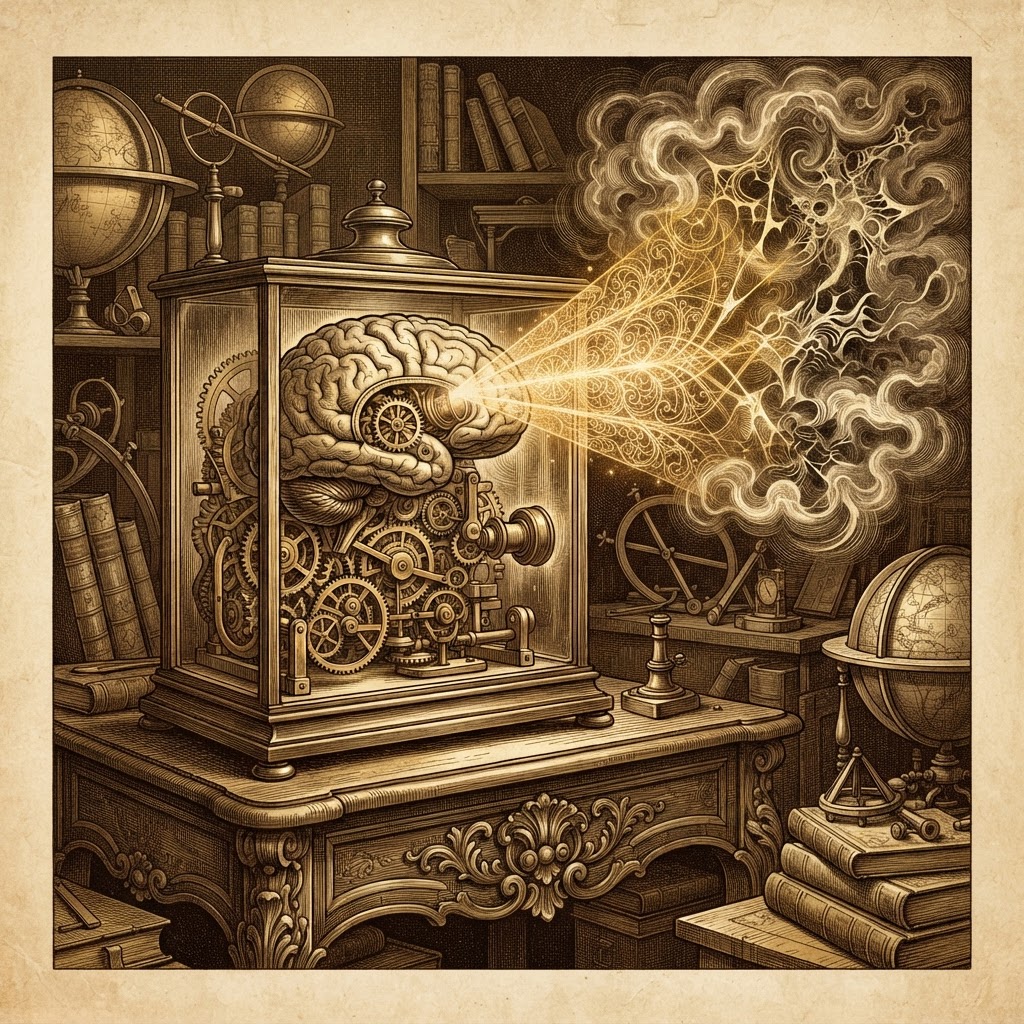
Contemporary predictive processing gives the idea a formal vocabulary. The brain is modeled as a hierarchical generative system. Higher levels encode broad expectations—objects, causes, meanings, and states of the body—while lower levels relay discrepancies. Perception emerges from the negotiation between these predictions and incoming signals. Crucially, not all errors count equally. Their influence depends on “precision,” roughly the system’s estimate of how reliable or important a signal is.
When the balance changes
Altered states can be understood as changes in the balance among prior beliefs, sensory evidence, and precision. This is not a single theory of every unusual experience, but a powerful organizing framework.
Dreaming offers an ancient example. During rapid-eye-movement sleep, sensory input from the outside world is greatly reduced, while internally generated activity remains vivid. The brain may therefore rely more heavily on its own generative models, producing perceptual worlds with little external correction. Dreams are not mere pictures switched on in the dark; they are immersive inferences whose evidence is largely self-produced.
Psychedelics pose a more intricate case. Robin Carhart-Harris and colleagues proposed the “REBUS” model—“relaxed beliefs under psychedelics”—arguing that psychedelics weaken the grip of high-level priors, especially rigid beliefs about the self and the world. In this account, normally suppressed signals and associations can influence consciousness more strongly. The result may be heightened novelty, unusual meaning, altered boundaries of self, and sometimes overwhelming uncertainty.
Neuroimaging studies have reported changes in large-scale brain networks, including reduced integrity or altered communication within the default mode network, a system associated with self-related thought. These findings do not prove that one network causes ego dissolution, nor that predictive processing explains every psychedelic effect. They do suggest that changes in how the brain coordinates high-level models may accompany changes in the felt self.
Psychosis, hallucination, and the weight of evidence
Predictive processing has also reshaped thinking about hallucinations and psychosis. Andy Clark and others have argued that perception can go wrong when internally generated predictions are assigned excessive precision. A weak or ambiguous signal may then be interpreted through an unusually confident model. In auditory verbal hallucinations, for example, internally produced speech might be experienced as externally authored when the brain’s model of agency fails to explain its own activity.
Other versions of the theory emphasize the opposite problem: sensory evidence may be granted too much precision, forcing the mind to revise stable interpretations in response to insignificant fluctuations. These differences matter. Predictive processing is not a single claim that “the brain hallucinates reality,” but a family of models whose value depends on specifying which predictions, errors, and weighting mechanisms change.
Why the framework matters
The framework’s enduring appeal is that it connects perception, action, emotion, and bodily regulation. Acting on the world can itself reduce prediction error: instead of revising the belief that a cup is within reach, the brain can move the hand toward it. Interoception—the sensing of the body—may similarly involve predictions about heartbeat, breathing, hunger, and threat. Feelings could therefore reflect the brain’s best ongoing model of bodily condition, not just readouts from organs.
This has practical implications. In psychiatry, it offers hypotheses about why anxiety can make ambiguous sensations feel dangerous, why depression can stabilize pessimistic expectations, and why psychedelic-assisted therapies might loosen entrenched models under carefully controlled conditions. In artificial intelligence, it provides a route toward systems that learn not only correlations but generative explanations. In philosophy, it revives an old question: how can a constructed experience nevertheless disclose a real world?
The framework also demands caution. Predictive processing is broad enough to risk becoming unfalsifiable if every observation is redescribed as prediction and error. Its strongest future will depend on precise computational models, preregistered experiments, and interventions that distinguish competing explanations.
What altered states reveal is not that perception is unreal. It is that reality, as lived, is actively assembled. The waking mind is a disciplined negotiator between expectation and evidence. Dreams, psychedelics, psychosis, and anesthesia expose what happens when the terms of that negotiation shift—and in doing so, they turn the familiar world into a laboratory for understanding consciousness.